
Sunday, 26 September 2010
The Blue Bird (1918)
'The Blue Bird' is a silent film directed by Maurice Tourneur. The story follows two children in their dreaming fantasies who seek the Blue Bird which is supposedly the source of all happiness. They are guided on their journey by friends, who are actually (and this is the part I am really interested in) the souls of ordinary objects like sugar and bread. As I watch, I plan to pay close attention to the theatrical and film devices he uses to animate objects. Notes to follow. Here's the complete restored film. Thanks YouTube.

Monday, 23 August 2010
Self Portrait by Kitty Huffman
If ever there was a self-portrait that captured the self in its wild peace then this is it. Sublime, mysterious, erotic.
Self Portrait from Kitty Huffman on Vimeo.
Monday, 26 July 2010
Saturday, 6 March 2010
Throb
Spewing horses hooves, chlorophyl, and honey; his breath storms her ribcage
and frees her heart from its torment; the frozen curse cast upon it when she
swore to God to save her from the rampaging fairies she mistook
for songs.
Column of air
and frees her heart from its torment; the frozen curse cast upon it when she
swore to God to save her from the rampaging fairies she mistook
for songs.
Column of air
Friday, 5 March 2010

Monday, 1 March 2010
Jupiter Eyeballed
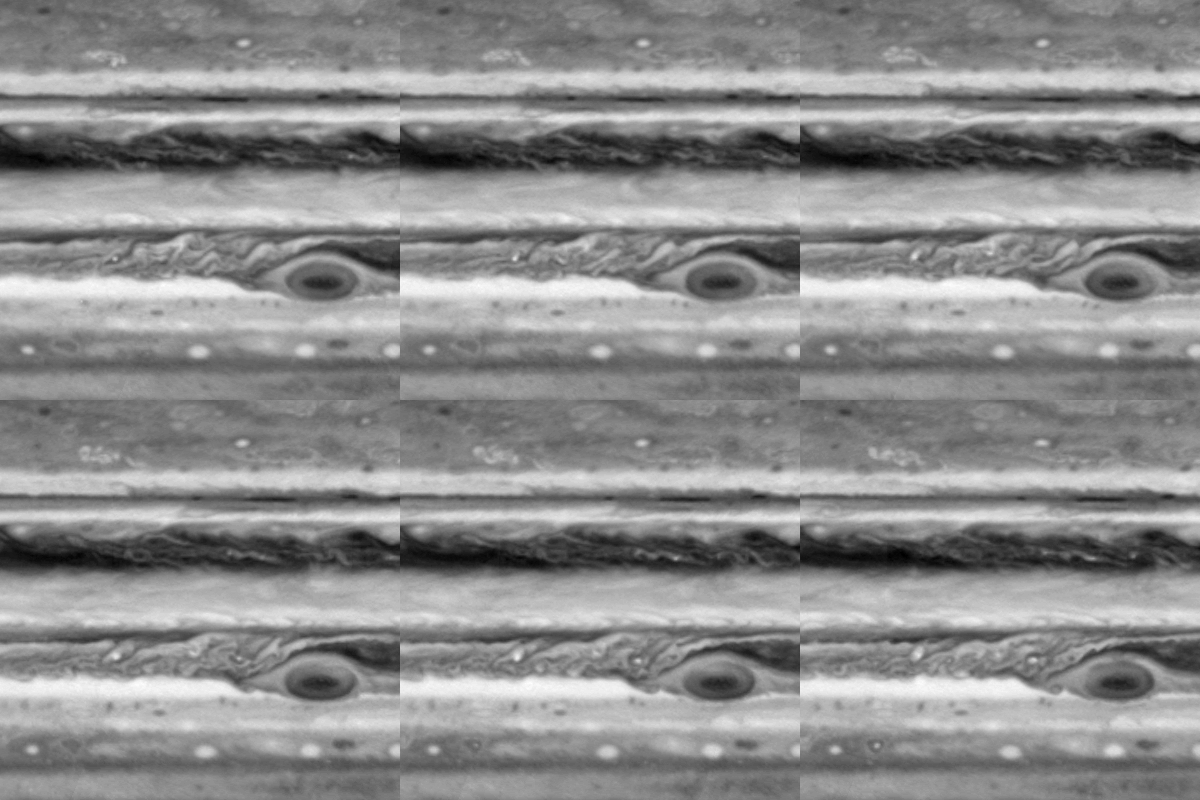
NASA's Hubble Space Telescope took this true-color view of Jupiter on February 17, 2007, using the planetary camera detector. Jupiter's trademark belts and zones of high- and low-pressure regions appear in crisp detail. Circular convection cells can be seen at high northern and southern latitudes.
The animated gif, below, is made up of a series of stills of Jupiter and gives the sense of the swirling thermodynamic atmosphere of this largest of planets. One of the four gas giants in our solar system.
I was prompted to dig out these Hubble images of Jupiter in order to compare them with a drawing of Jupiter from the 1870's that I happened upon in DoraBalla's blog archive. You can recognize Jupiter's gassy swirling bands. It must have taken a tremendous amount of time to do this observational drawing....looking through the telescope and capturing the movement of the gas bands. This drawing of 'Jupiter' and the next drawing of 'A Group of Sun Spots and Veiled Spots' are from The Trouvelot Astronomical Drawings Atlas 1870-80.

I was prompted to dig out these Hubble images of Jupiter in order to compare them with a drawing of Jupiter from the 1870's that I happened upon in DoraBalla's blog archive. You can recognize Jupiter's gassy swirling bands. It must have taken a tremendous amount of time to do this observational drawing....looking through the telescope and capturing the movement of the gas bands. This drawing of 'Jupiter' and the next drawing of 'A Group of Sun Spots and Veiled Spots' are from The Trouvelot Astronomical Drawings Atlas 1870-80.
I try to imagine doing an observational drawing of sun spots and I see the sun burning a hole right through my eyeball, tunnelling directly into my blind spot. A blinding needle dipped in a blood pool of light.


Tuesday, 1 September 2009
Hair Brained


I am working on some studies for braids and knots. In order to get my eyes to focus on the task at hand I gathered some images of hair braids off the net and photoshopped them so that i could see how they shape around the head. Hair brained.
Sunday, 30 August 2009
A philosophical investigation

"Said Doctor Bunny Rabbit, staring at his shadow black,
"Indeed, I had no notion that I looked so like a quack!"
I wanted to re-visit Wittgenstein's duckrabbit thought experiment after setting myself the task in the studio of pursuing 2 different approaches to drawing; namely, drawing from observation and drawing from my imagination. The idea was to consider how these 2 different approaches to drawing effected the outcome. Of course, I realize that making art is hardly an empirical process, and that setting up an 'experiment' in the studio often produces something unrelated to the experiment itself, it was nevertheless a means to look at how I see. What I found through these drawing exercises is that the process of looking and seeing (observing and imagining) are bridged by an hallucinatory space. While drawing I sense what I can only describe as a sort of zooming between microcosm and macrocosm; and a sort of flipping between inside and outside. This seems to be occurring both on the page and in my body. It feels so radically ambiguous, a perpetual de-stabilization of the figure and ground, body and page, tool and hand, eye and mind.
There is a clearly written introduction to Wittgenstein's Philosophical Investigations on wikipedia. I found 'A Shadow Show' on BibliOdyssey's blog.
Wednesday, 26 August 2009


Subscribe to:
Posts (Atom)


